
Hello and welcome back to another edition of movie and TV reviews by yours truly.
If you like the conversation, don’t hesitate to leave a like and a comment.
Now, this week’s film was rather disappointing, and I wasn’t quite sure what to make of this clusterfuck of a movie.
As you know, I’m a sucker for a good romance—an interracial one, no less—but I was quickly disappointed about thirty minutes in.
It felt clunky, like the writer was trying to address several different topics and wasn’t entirely successful.
I wasn’t quite sure what the point was, but here we are.
The film is none other than Black Tea.
The story begins in the Ivory Coast during Aya and Mr. Toussaint’s wedding.
The unhappy couple were already having issues in their relationship, but they chose to proceed with the ceremony anyway.
Fortunately—or unfortunately—Aya wisely chose to leave Toussaint at the altar and emigrate to Guangzhou, or Canton as Cai refers to it.
Cai is the forty-five-year-old married man she eventually becomes involved with.
There seem to be some undertones of racism throughout the film, as the locals refer to their little corner of the world as “Chocolate City.”
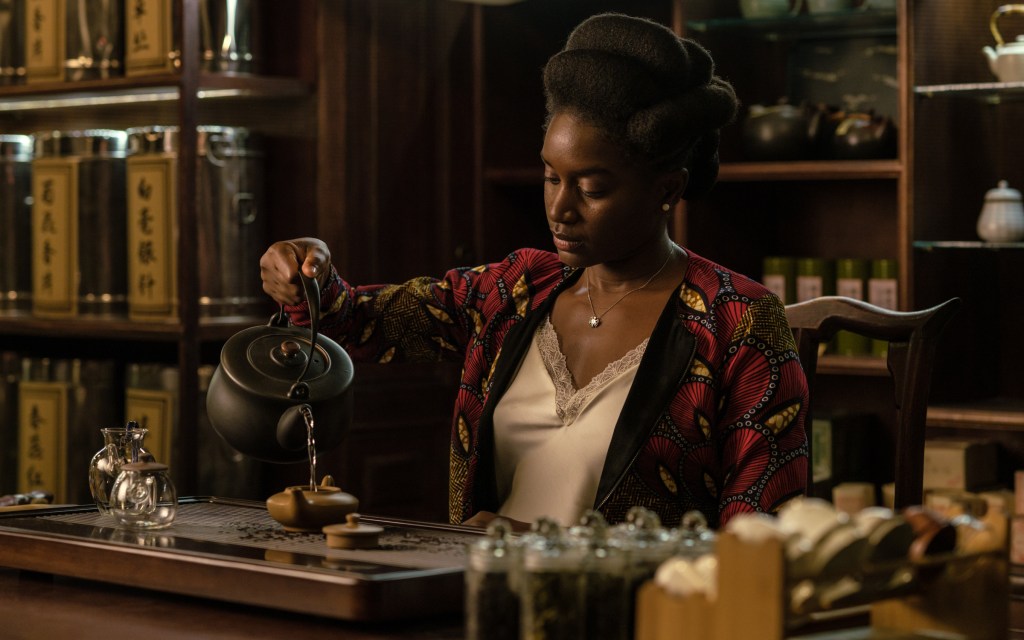
Cai, Aya’s lover, owns a tea shop where he instructs her in the art of the tea ceremony.
Now, I’m no tea connoisseur, but my guy was serving up a little more than your average teabag.
No pun intended.
Lol.
Honestly, I was turned off by their relationship the moment I found out Cai was married.
He and his wife seem to have an arrangement, as they have chosen not to divorce.
I believe this is largely for the benefit of their son, Li-Ben.
Aya chose not to marry Toussaint because she didn’t want to live a bitter life.
I found it strange that she could accept Cai knowing they were cheating—whether physically, emotionally, or both. The movie never really clarifies.
She couldn’t overlook Toussaint’s infidelity, but she was willing to participate in the same behavior with someone else.
Of course, Ying, Cai’s wife, says she doesn’t care.
I don’t entirely believe that.
Though their marriage was arranged, she must have felt something at one point.
Right?
There’s not much sympathy from me, though, because Cai isn’t exactly a nice guy.
He has a mean streak.
Not that I know everything that happened in their relationship, but yelling at Ying for dropping plates wasn’t exactly winning Husband of the Year.
And let’s not forget that he’s a serial cheater and a deadbeat father.
My guy has an entirely separate twenty-year-old daughter named Eva, the same age as Li-Ben.
Which means he was sleeping with the cook while married to his wife.
My guy is trash.
Lol.
Side Note
Apparently, it’s a thing for parents to stand around parks holding signs while looking for spouses for their children.
Arranged marriages are as old as time.
But the park?
Lol.
In short, I found myself more interested in the origin of Aya’s love of tea than I was in her actual relationship.
I also couldn’t understand Li-Ben.
One minute he’s upset with his father—not entirely because of the cheating, but because nobody told him.
Then a few scenes later, he’s sitting across from the other woman happily discussing birthday plans over dinner.
What the heck?
I would’ve been furious with everyone involved.
But maybe that’s just me.
Anypoops, I give this film 2 rose petals.
Maybe.
Lol.
I honestly don’t know.
What I do know is that Fatoumata Diawara’s rendition of Nina Simone’s Feeling Good was excellent.
You let me know.
Leave a Reply