
Happy New Year! And to my Indian patrons, Jai Hind!
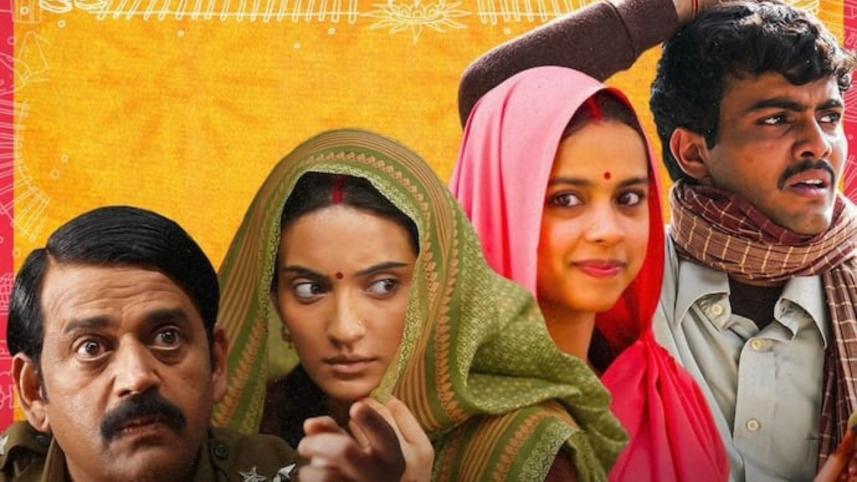
Welcome to another review of the week and the first of the year. The film up for review is none other than Laapataa Ladies! This gem took me on a rabbit-hole adventure through India’s culture. The film satirizes the culture surrounding the wedding sari and the women who wear them.
Everything about it was perfect: the story, the cast, and especially the soundtrack.
However, after watching the film for the first time, I had so many questions.
Now let’s get it!
The story takes place in Nirmal Pradesh, India, in 2001, at the height of scammed brides and brick Nokia cell phones. The background story is that there is a group of women robbing wedding jewels on the loose known as the Chandpur Bride Gang.
Now enter Phool and Pushpa, two brides on a train who briefly swap lives.
I love the magical logic of film because, no matter what, the show must go on. But in real life, this story could have gone very wrong.
Which leads me to my first pain point: Pushpa’s decision to stay silent throughout the whole trip to Deepak’s home.
I understand that she needed to get away from her husband, but couldn’t she have alerted him to the fact that she was not, in fact, his wife before getting home?
She could have been like,
“Bro, thanks for getting me this far. Just to let you know, I’m not her.”
And then she could have gone on her merry way.
They transferred multiple times before reaching his village, and the longer she hid that fact, the more danger Phool was in.
Phool lived a sheltered life, uninitiated to the full capacity of just how cruel the world around her could be. She could have easily become one of the girls we hear about being lost to prostitution.
I can’t be too mad at Pushpa, though. Her fate wouldn’t have been any better being married to that beast of a man.
She probably would’ve met the same fate as his previous wife.
That leads me to my next pain point: the way women are treated like objects.
I do not subscribe to the radical feminist idea that women don’t need men. That is foolish.
Men and women working together for the good of society is the height of perfection, as the late and great Maya Angelou said. But many of the feminists’ grievances are valid.
I am also not here to criticize India’s culture too much because my own is no better.
But it says something when a woman is branded like cattle with her husband’s name on her wedding day.
Some would say that I have a Western way of thinking, but should it be labeled Western to desire to be treated like a human being with intrinsic value?
Further, the mind is a terrible thing to waste, and Pushpa simply wanted to expand hers.
Her mother refused to allow her to attend school because she no longer believed farming was the way forward. Instead, she decided that sending her daughter to almost certain death would be their salvation.
She must have known something was up. A community like that talks, so the rumor mill must have been buzzing.
How desperate was she to believe this was the best decision?
No, I’m not saying school is a panacea for all poverty-ridden situations—we’ve all heard of the jobless graduate.
But education would’ve been the best decision in Pushpa’s case.
Now, it’s no secret that India has a caste system that restricts upward movement and even marriage between levels.
Apparently, it’s crass to ask which level someone’s family is from, but the film already pokes fun at the culture, so I’m just going to say it:
Bro had a lot of time to sit around and boo-hoo.
So that must mean he comes from wealth, or at least his family has money.
From the looks of him, I’d say Vaishya.
The Vaishyas are traders, farmers, and/or moneylenders.
I say all this because, in real life, would he really be like this?
Of course, the shame of losing his blushing bride would be on his mind, but who has time like that unless you have money?
The family is sustained by their large farm. It was Pushpa’s knowledge of natural bug repellent that stopped them from killing their crops with pesticides.
That being said, this leads me to my final pain point: Maai.
India isn’t exactly known for its love of women, and it’s evident in her opinion of Phool’s husband.
Her exact words were:
“He’s had his fun, taken your jewels, and dumped you.”
Why would he come back for her?
I don’t blame Maai for her negative sentiment toward men.
She was beaten and used by her useless husband and son.
Life robbed her of her joy and vitality, leaving her with a bitter taste in her mouth.
It’s no surprise she refused to eat Phool’s dessert.
Maybe I’m reading too much into it, but when Maai finally ate Phool’s dessert, I believe it brought a small spark of goodness back into her life.
And maybe it’s the hopeless romantic in me, but I felt Maai’s tears when Phool finally went home.
My favorite character has to be Inspector Manohar, hands down.
His sense of humor is unmatched.
He may be greedy, but he’s good at his job.
Most importantly, he is an honorable man.
He saved Pushpa’s life when he sent that rat on his merry way.
Anypoops, a fresh rose out of Queen Mirai’s private garden.
Let me know if you disagree, and why.
I’ve been too generous with these lately, but I think Laapataa Ladies genuinely deserves it.
Leave a Reply