
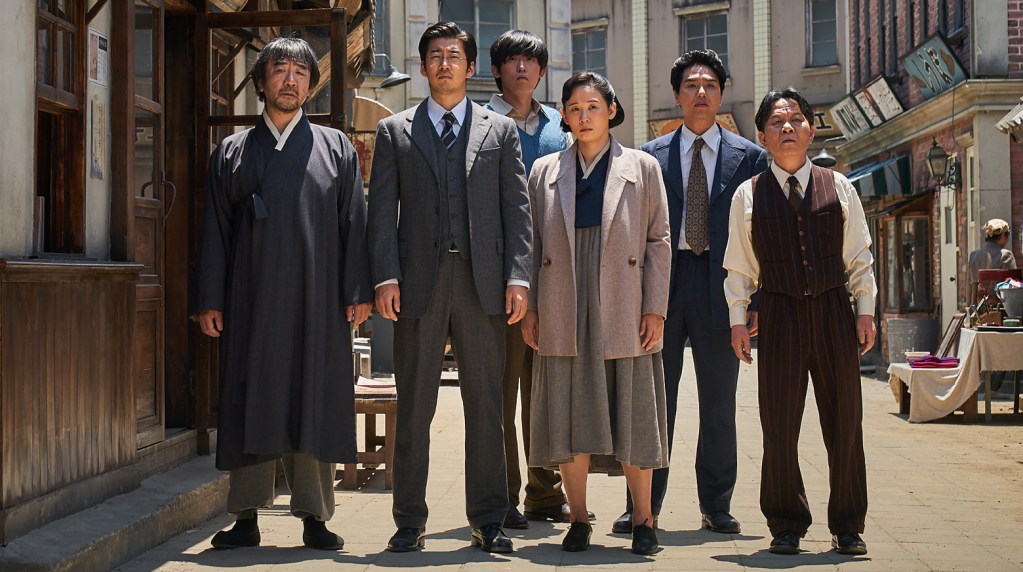
What hasn’t been said about the historic piece Mal-Mo-E: The Secret Mission? It is a work of cinematic beauty. A masterpiece.
Is it divisive?
Well, love it or hate it, it is impossible to remain impartial.
The movie has it all: a star-studded cast, comic relief, tension, moments of grief, and fear-inducing suspense.
Mal-Mo-E takes place in Korea in 1933, during the Japanese occupation. Of course, many atrocities took place, but the film focuses on the Japanese attempt to destroy the Korean language as a means of conquering the nation.
As a lover of language, and as someone whose mother tongue is not English, I can understand the desire to hold on to one’s native language, as it is a significant part of one’s identity.
Ryoo Jung-Hwan, the head honcho behind the dictionary, and his comrades do just that as they attempt to assemble words from different dialects throughout the country for their dictionary.
It is after a comedic run-in between Jung-Hwan and Kim Pan-Soo, a professional pickpocket, that the movie becomes truly interesting.
A Contrast Between Fathers
Throughout the film, I noted the relationships between both fathers and sons.
While Pan-Soo and Kim Duk-Jin initially begin estranged, over time they grow closer; whereas Ryoo Wan-Taek and Jung-Hwan’s relationship slowly deteriorates.
Demonizing Wan-Taek’s actions as those of a coward is too easy. He was merely protecting his son.
His decision to swallow the Japanese rhetoric couldn’t have been easy, and then to lose the respect of his son? He must have died a thousand deaths.
I can’t shame Wan-Taek too much, but it makes me wonder where Jung-Hwan found the faith to believe amidst all the chaos. Maybe it was sheer resentment toward all things Japanese.
On one hand, we have Pan-Soo, who dies like a dog in the corner, but he dies with the greatest honor.
Sadly, it leaves Duk-Jin and Soon-Hee as orphans, but his actions preserve their language for generations.
Literacy
It always baffles me when I hear of someone who can’t read or write.
Maybe that shows how sheltered I am, but I believe education should be a right guaranteed to every human being.
I understand now that it is a common problem, and it makes me more grateful for my education.
This leads me to my first pain point—or rather, Pan-Soo’s pain point.
After observing his character, I can’t imagine he was a good student. He must have been the troublemaker in class.
And it’s only after becoming an adult that he realizes what he missed.
It certainly seems like a thorn in his side not being able to provide for his family, not to mention his son’s open disgust for his lifestyle.
So it is especially rewarding to see Pan-Soo progress as an adult student.
Forgiveness
I have no clue how historically accurate this film is, and obviously some scenes were dramatized for effect.
But the movie is persuasive enough that it leaves a certain distaste for the Japanese.
That being said, I ask: when, or even how, do we move forward?
Let it be known, I’m not saying forget—but forgive.
In passing, I’ve heard people from that generation, or their children, speak of how they would never forgive, or how difficult they find it to deal with Japanese people.
Maybe I’m just naïve, and I should keep my nose out of other nations’ affairs.
But like anyone else, I have made major mistakes, and I hope those I have offended will forgive me.
No nation is perfect, so what steps can we take toward restoration?
These are just my thoughts.
For this movie, I don’t have a favorite protagonist. Each character played their part equally well.
However, Ueda stood out to me the most.
I don’t want to see whatever hell he’ll be going to.
It’s no wonder he’s a high-ranking officer. He wields his power mercilessly.
That adage about being only as strong as your weakest link is true, and Ueda took full advantage of it.
The wife was likely already dead when he approached Min Woo-Chul, the youngest member of the group, about a deal to release her in exchange for information about the dictionary.
I had the inkling she was already dead, and he all but confirmed it when he offered to release her.
He’s too trigger-happy.
Once I saw him shoot Teacher Jo, I was almost certain he would shoot Duk-Jin during the interrogation. Instead, he only shot the father in the leg.
Still sad, but I’d rather the old man on the verge of death than the little boy.
After their father died, I was getting Grave of the Fireflies vibes, but thankfully Duk-Jin and Soon-Hee survived.
Anypoops, 5 out of 5 rose petals.
Leave a Reply